What is ketamine-assisted psychotherapy (KAP)?

At our clinic, we offer ketamine-assisted psychotherapy (KAP), delivered under a psychiatrist's eligibility assessment and ongoing medical monitoring. It is one form of psychiatric care known as psychedelic-assisted therapy. This newer approach has taken its present shape through more than half a century of scientific research, building on cultural and spiritual practices that humanity had already been refining for far longer.

This page is written for anyone without specialist background (whether you're considering this treatment for yourself or a family member) who wants to understand what psychedelic-assisted therapy actually is.

What is psychedelic-assisted therapy?

Psychedelic therapy is a psychiatric approach that combines a substance capable of shifting consciousness with psychosocial support, also known as psychedelic-assisted therapy.

As the word "assisted" suggests, the substance supports the treatment; it does not complete it on its own. A preparation session beforehand, close support on the day of the session, and a structured review afterward (integration): only together with this psychological support does any of it deserve to be called treatment. That is the basic position of this therapy.

Our ketamine-assisted psychotherapy (KAP) is designed along these same lines.
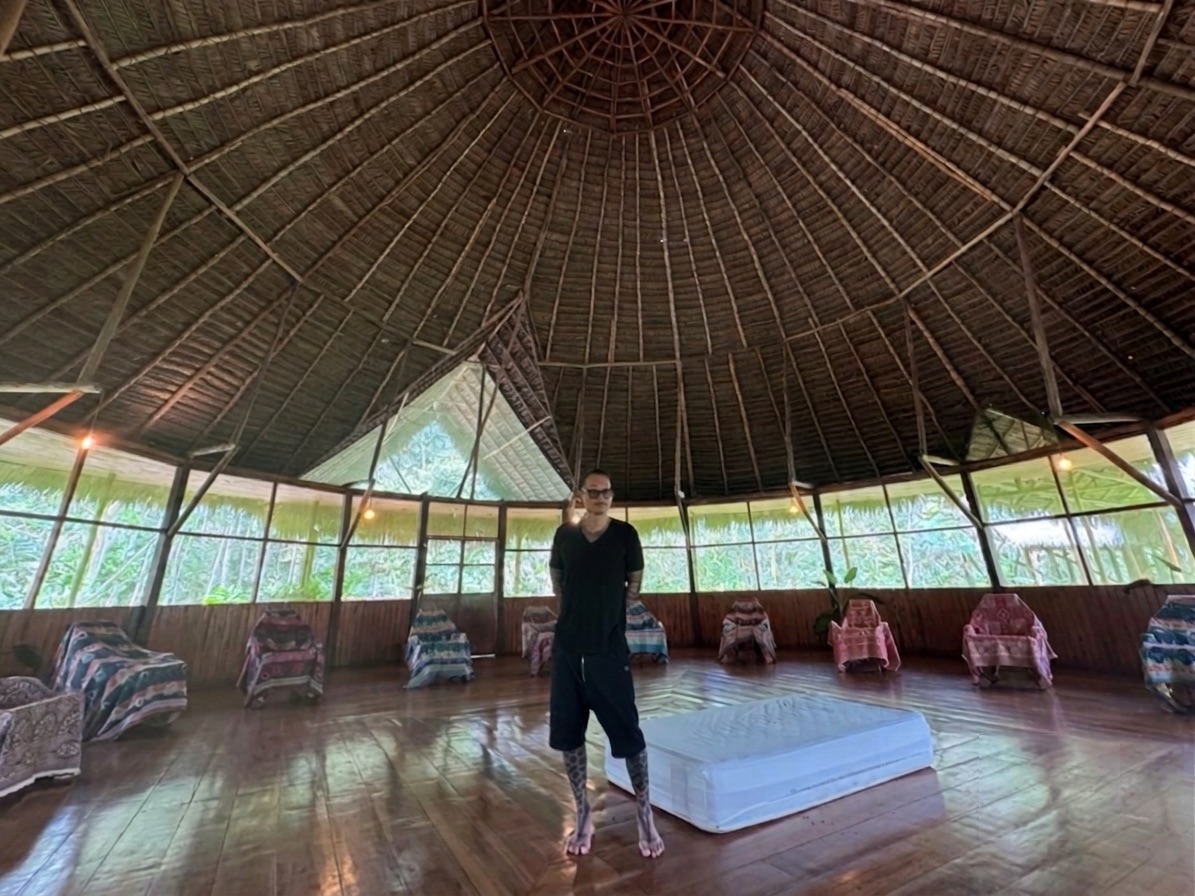
A circular thatched hall opening onto forest, with a wooden floor and a person standing at the center
Our director taking part in an ayahuasca session. Peruvian Amazon.

Not just medication

With conventional antidepressant treatment, you take medication daily, gradually shifting the brain's neurotransmitter balance over weeks. In most cases, no unusual experience is expected along the way. Daily life simply continues while you wait for the effect to build.

Psychedelic-assisted therapy works on a different premise. Here, the shift in consciousness that occurs during the session is treated as part of the treatment itself. Stepping temporarily outside your usual patterns of thought can open a chance to look at yourself, and your past experiences, from a new angle. A number of clinical studies have explored this framework.

That's why this treatment weighs "what mindset, what environment, and what support surrounds the experience" just as heavily as "which drug, at what dose." The concept of set and setting (mindset and environment), explained next, sits at the core of this.

Set and setting

Psychedelic therapy has long centered on one core concept: set and setting (mindset and environment).

Set refers to the mental state, preparation, intention, and expectations a person brings into the experience. The idea is that the very same substance can produce a very different quality of experience depending on whether someone arrives anxious and unprepared, or arrives having shared a clear sense of purpose. Our preparation session exists to help build this set.

Setting refers to the physical and interpersonal environment in which the experience takes place: whether the space feels calm and safe, whether a trusted clinician is present. These environmental factors have long been understood to shape the experience itself. Holding sessions on-site, with a clinician present throughout, serves medical safety, but it's also how we shape this setting.

The insight that the same substance can produce an entirely different experience depending on mindset and environment is exactly what separates psychedelic therapy from simple medication. Administering the substance is never the end point. This field has consistently placed its emphasis on designing what happens before and after, so that the experience itself becomes therapeutic.

Why ketamine

A number of substances have been studied within psychedelic therapy. Our choice to use ketamine specifically comes down to medical reasoning.

Ketamine was developed in the 1960s and has been used as an anesthetic worldwide for more than half a century, giving it well-documented action and safety. In recent years, at doses far lower than those used for anesthesia, it has been reported to produce a comparatively rapid antidepressant effect in depression that had not improved sufficiently with existing antidepressants. Clinical studies report that changes can appear within hours to 24 hours of administration.

Ketamine's pharmacology differs from that of most classic psychedelics (it's believed to act on the brain's glutamate signaling system), but depending on dose and environment, it can still bring on shifts in consciousness, including altered perceptions of reality (a dissociative experience). Ketamine-assisted psychotherapy uses this property under medical supervision, combined with psychological support.

Ketamine is also thought to open a "neuroplasticity window" after administration—a period when the brain may form new connections more readily. We place such weight on preparation and integration around the experience because layering psychological support onto this more malleable period is believed to help the experience take root in daily life afterward.

In Japan, ketamine is approved as an anesthetic, but its use for depression is off-label (not approved for that indication). We explain this clearly at your first visit and proceed only after you've signed a consent form (see Important notice for details).

Integration

The concept most often overlooked in understanding psychedelic treatment, and yet the most important one, is integration.

On its own, what happens during a session is just something that happened. Integration is the work of translating what you noticed, felt, or came to see during that experience into everyday language, and finding its place in the life you go back to. Many practitioners in this field have come to believe that what determines a treatment's outcome is less the session itself than the integration that follows it.

A quiet stone stairway leading into a tree-lined path

This is why our treatment places a preparation session before the ketamine session, and an integration session plus a two-week follow-up afterward. The design deliberately weighs the time spent talking with a mental health professional (before and after) more heavily than the time spent administering the substance.

What we provide is never just the administration of a drug. It's the full arc of preparation, experience, and integration.

Rituals and Psychiatry

Psychedelic treatment didn't appear out of nowhere as some new technology. It stands on a long accumulation of both culture and science.

Practices for deliberately altering consciousness have existed since ancient times, embedded in traditional cultures and religious rituals across the world. In the mid-20th century, several such substances became subjects of Western medical and psychological research, and through the 1950s and '60s they were seriously studied within psychiatry. Much of the therapeutic framework we still rely on today (set and setting among it) took shape during that period.

A single candle flame burning quietly in the dark

Social and regulatory pressures then forced research into a long hiatus. These substances found a new home in cultural contexts such as the counterculture and spirituality, and were cut off from mainstream medicine. Even so, clinicians and researchers who believed in their therapeutic potential kept the experience and methodology alive.

From the 1990s onward, research began to move again under rigorous scientific protocols. This shift is known as the "psychedelic renaissance": today, clinical studies are underway at major universities and medical centers worldwide, and the field has reached the stage of formal drug-approval review by agencies such as the FDA and TGA.

Human experience carried forward through folk tradition, religion, and the counterculture has thus been gradually translated into the language of science, and is now being welcomed back into psychiatric medicine as psychedelic treatment.

Where the science stands

Talk of "history and culture" might sound unscientific, but today the field is advancing through rigorous clinical trials and formal drug-approval review. The United States, and Australia (the first country to authorize psychiatrists to prescribe these substances therapeutically) are leading its clinical application. Below are some of the key recent developments, briefly.

Esketamine (a form of ketamine) was approved by the U.S. Food and Drug Administration (FDA) for treatment-resistant depression in 2019, and its approval as a standalone therapy was reported in January 2025. In Japan, however, it remains unapproved for depression.

In Australia, since July 2023, psychiatrists who meet specific requirements have been able to prescribe MDMA and psilocybin for therapeutic use within a defined regulatory framework. It stands as one of the first cases in the world where a national regulator, the Therapeutic Goods Administration (TGA), established a formal framework for this kind of psychiatric care.

Psilocybin (the active compound in certain mushrooms) has reportedly produced favorable results in large-scale Phase 3 clinical trials for treatment-resistant depression, and is said to be moving toward approval review by the U.S. FDA (Food and Drug Administration).

None of this is a fringe experiment. It shows a part of modern medicine being evaluated on the same terms as any other pharmaceutical. At the same time, the work is still underway, and it's important to approach it without excessive expectations, understanding its limits along with its promise.

The situation in Japan

In Japan, ketamine is a pharmaceutical approved as an anesthetic, but it is subject to regulation under the Act on Narcotics and Psychotropics and is used under strict management. Its use for depression is off-label (not domestically approved) for that purpose. The esketamine nasal spray approved in the U.S. and elsewhere also remains unapproved in Japan.

As a result, receiving ketamine treatment for depression in Japan is private care not covered by insurance. The full cost is borne by the patient, and care is provided under a framework distinct from ordinary insured care. We explain this at your first visit.

Precisely because this is off-label, private-pay treatment, who provides it (and under what evaluation and system of care) matters a great deal. Under the guidance and supervision of a board-certified anesthesiologist, our clinic provides a psychiatrist's eligibility assessment, continuous monitoring during sessions, collaborative care with mental health professionals, and the full process from preparation through integration.

Our treatment

Our ketamine-assisted psychotherapy is never simply the administration of a drug. It's a treatment process woven together with psychological support, beginning with a preparation session that shapes set and setting, moving through a medically supervised session, and continuing into integration and follow-up. This design implements, within a modern psychiatric framework, the methodology that psychedelic therapy has spent more than fifty years building to turn an experience into something therapeutic.

This treatment's roots lie in cultural, religious, and philosophical traditions, and it's that accumulated history that made today's medical approach possible. At the same time, what we practice here is psychiatric medicine, built on a foundation of medical eligibility assessment and safety management. For details, see the Who it's for page.

Common misconceptions

Will I lose consciousness or my memory?
No. Ketamine-assisted psychotherapy uses a dose far lower than an anesthetic dose, and patients typically remain conscious throughout the experience. During your preparation session, we'll explain in advance what the experience is like and how to work with it.
Will one session cure me?
We can't promise that. Clinical studies suggest that multiple sessions may contribute to more lasting change, but that is not a guarantee. Suitability is decided at the first-visit assessment. For details, see the Who it's for page.
Will I be pushed into a spiritual experience?
No. What we practice is psychiatric medicine. How you make sense of the experience is entirely your own. We never ask you to adopt any particular belief or interpretation. The integration session is simply a conversation to help you put the experience into your own words.

Further reading

← Back to home